Portland Art Bronze Bas Relief Map of the River


Ancestral shrine in Royal Palace, Benin Metropolis, 1891: the earliest-known photograph of the Oba's chemical compound. Note 'bronze' heads at both ends of the shrine.
The Benin Bronzes are a group of several thousand[a] metal plaques and sculptures that decorated the purple palace of the Kingdom of Benin in what is at present Nigeria. Collectively, the objects form the all-time examples of Benin fine art, and were created from the thirteenth century onwards by artists of the Edo people.[3] [4] Autonomously from the plaques, other sculptures in brass or statuary include portrait heads, jewellery and smaller pieces.
Many of the dramatic sculptures date to the thirteenth century, and a large part of the collection dates to the fifteenth and sixteenth centuries. It is believed that 2 "golden ages" in Benin metal workmanship occurred during the reigns of Esigie (fl. 1550) and of Eresoyen (1735–1750), when their workmanship accomplished its highest quality,[5] periods in which about of Benin'south wealth was a product of its participation in the Transatlantic slave merchandise.[half-dozen] [7]
Most of the plaques and other objects were looted past British forces during the Benin Expedition of 1897 equally royal control was being consolidated in Southern Nigeria.[8] Ii hundred pieces were taken to the British Museum in London, while the rest plant their way to other European museums.[9] A large number are held by the British Museum[eight] with other notable collections in Germany and the United states.[x]
The Benin Bronzes led to a greater appreciation in Europe of African culture and art. Initially, information technology appeared incredible to the discoverers that people "supposedly so archaic and savage" were responsible for such highly adult objects.[eleven] Some fifty-fifty wrongly concluded that Republic of benin cognition of metallurgy came from the Portuguese traders who were in contact with Benin in the early modern period.[eleven] The Kingdom of Benin was a hub of African civilization long before Portuguese traders visited,[12] [13] and it is clear that the bronzes were made in Benin by an indigenous civilization, centuries earlier European contact.
While the collection is known as the Benin Bronzes, like virtually West African "bronzes" the pieces are mostly made of contumely of variable limerick.[b] There are also pieces made of mixtures of bronze and brass, of wood, of ceramic, and of ivory, amid other materials.[15] The metal pieces were fabricated using lost-wax casting and are considered among the all-time sculptures made using this technique.[sixteen]
History [edit]
Social context and creation [edit]
"The king's palace or court is a square, and is as large as the town of Haarlem and entirely surrounded by a special wall, like that which encircles the town. It is divided into many magnificent palaces, houses, and apartments of the courtiers, and comprises beautiful and long square galleries...resting on wooden pillars, from peak to bottom covered with bandage copper, on which are engraved the pictures of their war exploits and battles, and are kept very clean."
Olfert Dapper, a Dutch writer, describing Benin in his book Clarification of Africa (1668)[17]
The Kingdom of Benin, which occupied southern parts of present-24-hour interval Nigeria between the fourteenth and nineteenth centuries, was rich in sculptures of various materials, such equally iron, statuary, woods, ivory, and terra cotta. The Oba's palace in Republic of benin, the site of production for the imperial ancestral altars, besides was the backdrop for an elaborate courtroom ceremonial life in which the Oba of Benin, his warriors, chiefs and titleholders, priests, members of the palace societies and their elective guilds, foreign merchants and mercenaries, and numerous retainers and attendants all took part. The palace, a vast sprawling agglomeration of buildings and courtyards, was the setting for hundreds of rectangular brass plaques whose relief images portray the persons and events that blithe the courtroom.[xviii]
Statuary and ivory objects had a variety of functions in the ritual and ladylike life of the Kingdom of Benin. They were used principally to decorate the royal palace, which contained many bronze works.[nineteen] They were hung on the pillars of the palace past nails punched through them.[18] As a courtly fine art, their principal objective was to glorify the Oba—the divine king—and the history of his imperial power or to honour the Iyoba of Benin (the queen mother).[20] Art in the Kingdom of Republic of benin took many forms, of which bronze and brass reliefs and the heads of kings and queen mothers are the best known. Bronze receptacles, bells, ornaments, jewellery, and ritual objects also possessed aesthetic qualities and originality, demonstrating the skills of their makers, although they are often eclipsed by figurative works in bronze and ivory carvings.[20]
In tropical Africa the technique of lost-wax casting was developed early, as the works from Republic of benin show. When a king died, his successor would order that a bronze head be made of his predecessor. Approximately 170 of these sculptures be, and the oldest date from the twelfth century.[21] The oba, or king, monopolized the materials that were almost difficult to obtain, such as gold, elephant tusks, and statuary. These kings fabricated possible the creation of the splendid Benin bronzes; thus, the purple courts contributed substantially to the development of sub-Saharan art.[22] In 1939, heads very like to those of the Kingdom of Republic of benin were discovered in Ife, the holy city of the Yoruba, which dated to the fourteenth and fifteenth centuries. This discovery supported an earlier tradition property that information technology was artists from Ife who had taught Republic of benin the techniques of bronze metalworking.[23] Recognition of the antiquity of the technology in Republic of benin avant-garde when these sculptures were dated definitively to that era.[24]
European interest and the Benin Trek of 1897 [edit]

Few examples of African art had been collected by Europeans in the eighteenth century. Only at the commencement of the nineteenth century, when colonization and missionary action began, did larger numbers of African works begin to be taken to Europe, where they were described as simple curiosities of "pagan" cults. This mental attitude changed later the Benin Expedition of 1897.
In 1897, the vice delegate general James Robert Phillips, together with 6 other British officials, two businessmen, translators, and 215 porters, set off toward Benin from the small port of Sapele, Nigeria,[xi] intending to overthrow the rex (Oba) of Benin.[26] Although they had given give-and-take of their intended visit, they were later informed that their journeying must exist delayed, considering no foreigner could enter the urban center while rituals were beingness conducted;[27] [28] yet, the travellers ignored the alarm and continued on their trek.[29] They were ambushed at the south of the city by Oba warriors, and only 2 Europeans survived the ensuing massacre.[xi] [27]

Illustration of Benin City in 1897, drawn past a British official
News of the incident reached London eight days later and a naval punitive expedition was organized immediately,[11] [27] [29] which was to be directed by Admiral Harry Rawson. The expedition sacked and destroyed Benin Metropolis.[11] [27] Following the British attack, the conquerors took the works of fine art decorating the Royal Palace and the residences of the nobility, which had been accumulated over many centuries. According to the official business relationship of this event written by the British, the attack was warranted because the local people had ambushed a peaceful mission, and because the expedition liberated the population from a reign of terror.[27] [30] Further, these objects were accounted "spoils of war", pregnant that their rightful ownership was upwards for debate equally soon as the attack began. This ambiguity surrounding the objects' ownership has made it difficult for the Republic of benin Kingdom (present twenty-four hour period Nigeria) to reclaim their property.[31]
The works taken by the British were a treasure hoard of bronze and ivory sculptures, including king heads, queen mother heads, leopard figurines, bells, and a corking number of images sculpted in loftier relief, all of which were executed with a mastery of lost-wax casting. In 1910, High german researcher Leo Frobenius carried out an trek to Africa with the aim of collecting works of African fine art for museums in his country.[32] Today mayhap as few as 50 pieces remain in Nigeria although approximately 2,400 pieces are held in European and American collections.[33]
Division among museums [edit]


The Benin Bronzes that were function of the haul of the castigating expedition of 1897 had different destinations: one portion concluded up in the private collections of various British officials; the Foreign and Commonwealth Office sold a big number, which subsequently ended upward in diverse European museums, mainly in Germany, and in American museums.[10] The high quality of the pieces was reflected in the high prices they fetched on the marketplace. The Foreign Office gave a big quantity of bronze wall plaques to the British Museum; these plaques illustrated the history of the Republic of benin Kingdom in the fifteenth and sixteenth century.[30]
| Museum collections of Benin Bronzes [34] | ||
|---|---|---|
| City | Museum | Number of pieces |
| London | British Museum | 700 |
| Berlin | Ethnological Museum of Berlin | 580 |
| Oxford | Pitt Rivers Museum | 327 |
| Vienna | Weltmuseum Wien | 200 |
| Hamburg | Museum of Ethnology, Museum of Arts and crafts | 196 |
| Dresden | Dresden Museum of Ethnology | 182 |
| New York | Metropolitan Museum of Art | 163 |
| Philadelphia | University of Pennsylvania Museum of Archeology and Anthropology | 100 |
| Leiden | National Museum of Ethnology | 98 |
| Leipzig | Museum of Ethnography | 87 |
| Cologne | Rautenstrauch-Joest Museum | 73 |
| London | Horniman Museum | 49 |
| Washington, DC | National Museum of African Art | 39 (will exist repatriated)[35] |
| Boston | Museum of Fine Arts | 28[36] |
| Basel | Museum of Cultures (Basel) | 20 |
| Los Angeles | UCLA's Fowler Museum | 18 |
| Glasgow | Glasgow Museums | 8 |
| Caracas | Museum of Afroamerican Art | three |
| Zürich | Rietberg Museum | 2 |
| Bristol | Bristol Museum | two |
| Republic of benin Urban center | Benin City National Museum | 2 |
| Dallas | Dallas Museum of Art | Probably one |
| San Francisco | De Immature Museum | Probably one |
| Aberdeen | The University of Aberdeen Museum | 1 (repatriated) |
| Szczecin | National Museum, Szczecin | 1 (found at a flake g in 1977)[37] |
| Windsor | Windsor Castle | 1 (gifted)[38] |
| Toronto | Royal Ontario Museum | 1 |
| Tervuren | Majestic Museum for Central Africa | one |
| Vermont | Fleming Museum of Art | one |
| Boston | Harvard Fine art Museum | Probably 1 |
| Boston | Peabody Museum of Archaeology and Ethnology | sixty |
| Connecticut | Yale Academy Fine art Gallery | 8 |
Subsequent sales and restitutions [edit]
The 2 largest collections of Benin Bronzes are located in the Ethnological Museum of Berlin and in the British Museum in London, while the third largest drove is located in several museums in Nigeria (principally the Nigerian National Museum in Lagos).[39] [40]
Since gaining independence in 1960, Nigeria has sought the return of the bronzes on several occasions.[39] [41] In that location has also been extensive fence over the location of the bronzes existence distant from their place of origin. Ofttimes, their return has been considered emblematic of the repatriation of the African continent. The artefacts have become a test case in the international debate over restitution, comparable to that of the Elgin Marbles.[42] [43]
The British Museum sold more than than 30 Benin Bronzes to the Nigerian government between 1950 and 1972. In 1950, the museum's curator Hermann Braunholtz declared that, although made individually, of the 203 plaques acquired by the Museum in 1898, thirty were duplicates; because they were identical representations, he determined that they were superfluous for the museum and were sold.[43] The sales stopped in 1972 and the museum's African fine art specialist said that they regretted the sales.[43] A newspaper publication revealed that in 1953, Sotheby'due south sold a Benin Bronze head for £5,500 when the previous record sale was £780.[44] In 1968, Christies sold for £21,000 a Republic of benin Head that was discovered by an officer effectually his neighbor's greenhouse. In 1984, Sotheby'south auctioned a plaque depicting a musician; its value was estimated at between £25,000 and £35,000 in the sale catalogue.[30]
In 2015, a Benin Statuary head was sold to a private collector for a record fee of £10m.[45] [46] In 2018, a bargain was struck past the Benin Dialogue Group (BDG) and the authorities in London to return Benin Bronzes that will be used to grade a temporary exhibition at the New Benin Imperial Museum in Edo Land.[47] The group comprises representatives of several museums, the Majestic Court of Benin, Edo State Regime and the Nigerias National Commission for Museums and Monuments. In 2015, Marking Walker returned some Republic of benin Bronzes that were taken past his grandfather during the siege on Republic of benin Kingdom and he was received by Prince Edun Akenzua in Benin City.[48] [49]
In 2020, French republic approved the restitution of 26 items that had been pillaged in 1892.[fifty] [51] [52] In the same yr, Nigeria took receipt of a terra cotta caput that was believed to be effectually 600 years quondam, which had been smuggled out of Nigeria.[ commendation needed ] [ description needed ]
The University of Aberdeen agreed in March 2021 to return a bronze head of an oba, that had been purchased at an sale in 1957.[53] [54]
In April 2021, the German language regime alleged the restitution of looted Benin bronzes in Germany's public collections by 2022.[fifty] Hartmut Dorgerloh, the director of the Humboldt Forum, which incorporates the Ethnological Museum of Berlin, said at a press upshot that exhibiting the Republic of benin bronzes in the new museum complex in Berlin every bit earlier planned is "now not imaginable".[55] [56] Also in Apr 2021, the Church of England also promised to return ii benin bronzes that were given as gifts to the then Archbishop of Canterbury Robert Runcie almost 40 years ago.[57] These bronzes were also part of the ones that will exist used to set the New Republic of benin Royal Museum.[ needs update ] In the same month, the Horniman Museum in Southward London said it was considering legal advice in terms of repatriation and restitution of 49 works from Benin Urban center including xv contumely plaques, weapons and jewellery in its possession.[58]
In response to the British Museum's continued refusal to render looted Benin bronzes, the Iyase of Benin Metropolis unveiled the largest bronze plaque to date on thirty July 2021.[59] [60] [61] The plaque contains over two tons of contumely and was created by 1 of the grandsons of the electric current Iyase (traditional prime government minister) of Benin Kingdom, Lukas Osarobo Zeickner-Okoro.[62] Information technology is titled 'The Render of Oba Ewuare' to symbolise the Benin belief in reincarnation and a restart of the Republic of benin Bronze age in the reign of the current Oba of Benin, Ewuare II. It therefore honours the Oba and was even offered in commutation for the looted bronzes held by the British Museum.[63] [64]
In Oct of the same twelvemonth, Jesus College, Cambridge, appear that it would exist repatriating a sculpture of a cockerel, known as Okukor, to Nigeria, on the 27 October, afterwards the pupil torso brought to calorie-free its historical significance as a looted artefact.[65] The statue had previously been removed from display in 2016, later educatee calls for the statue to exist repatriated; post-obit investigation by the college's Legacy of Slavery Working Political party (LSWP), it was ascertained that the statue had been straight taken from the court of Benin, and had been gifted to the higher, by the father of a student, in 1905.[65]
In November, 2021, the Metropolitan Museum of Art transferred ii 16th century Bronze plaques, a Warrior Primary and Junior Courtroom Official to the National Commission for Museums and Monuments. This transfer is non to be dislocated equally a response to repatriation requests, as the Institution owns a collection of nigh 160 Benin Bronzes. Instead, the Museum describes this transfer as a return of plaques that were stolen from the National Museum in Lagos in the 1950s.
In January 2022, the Great N Museum: Hancock in Newcastle, England, agreed to return a Benin Bronze stave to Nigeria.[66]
Two Benin bronzes, from Aberdeen University and Jesus College were returned[67] to their ancestral home in Feb 2022. The artefacts, the bronze cockerel Okukor, and a king'south bust were returned to a traditional palace in Benin Urban center in Nigeria. They volition exist installed at the Edo Museum of West African Fine art in Republic of benin Urban center in one case it is completed.
In March 2022, the Smithsonian announced that 39 bronzes in its National Museum of African Fine art would be repatriated. The bronzes will continue display at the National Museum of Benin.[35]
The works [edit]

A Benin Bronze depicting the Benin's Oba palace - British Museum
The Benin Bronzes are more than naturalistic than most African art of the menstruation. The statuary surfaces are designed to highlight contrasts betwixt light and metal.[68] The features of many of the heads are exaggerated from natural proportions, with large ears, noses, and lips, which are shaped with great intendance.[69] The nearly notable aspect of the works is the high level of metal working skill at lost-wax casting. The descendants of these artisans withal revere Igue-Igha, as the person who introduced the art of casting to the Kingdom of Benin.[68]
Another important attribute of the works is their exclusivity: holding was reserved merely for certain social classes, reflecting the strict hierarchical structure of club in the Kingdom of Benin. In general, but the king could own objects made of bronze and ivory, however, he could allow loftier-ranking individuals to employ such items, such equally hanging masks and cuffs made of bronze and ivory. Coral was also a royal textile. Coral neck rings were a symbol of dignity and utilize was granted specifically past the Oba.[20]
Themes [edit]

The rectangular plaques be in two formats. In 1, the long vertical sides are turned back, creating a small edge that is decorated with an incised guilloché pattern. In the other format, which is much narrower, the turned-dorsum edges are missing and the design of the plaque groundwork ends abruptly, as if cut off. These variations probably reflect the size and shape of the palace pillars and the system of the plaques on them. The plaques are by and large about 1/8 inch thick.[eighteen]
The backgrounds on the front of most of the plaques are incised with foliate patterns bearing ane to four leaves, which is referred to every bit ebe-ame, or the "river leaf" design.[70] The leaves were used in healing rites by priestesses of Olokun, the god of the sea.[71]
Some of the reliefs represent important battles of the sixteenth-century wars of expansion; however, the majority depict dignitaries wearing ceremonial clothes. Almost of the plaques portray static figures, either alone, in pairs, or in minor groups arranged hierarchically around a central figure. Many of the figures depicted in the plaques may be identified just through their clothing and emblems, which indicated their rank and part in the court, simply not their private identities. Although in that location have been attempts to link some of the depictions with historical figures, these identifications take been speculative and unverified. In certain cases, the lack of data fifty-fifty extends to the functional roles of some figures, which cannot conclusively be determined.[20]

A Benin Bronze depicting 3 Benin warriors
The statuary heads were reserved for bequeathed altars. They were also used as a base of operations for engraved elephant tusks, which were placed in openings in the heads. The commemorative heads of the male monarch or the queen mother were not individual portraits, although they show a stylized naturalism. Instead, they are archetypical depictions; the mode of their design changed over the centuries, which also occurred with the insignias of the depicted royalty. The elephant tusks with decorative carvings, which may have begun being used as a decorative element in the eighteenth century, testify distinct scenes from the reign of a deceased king.[20]
As a prerequisite for royal succession, each new Oba had to install an altar in award of his predecessor. Co-ordinate to popular belief, a person'due south head was the receptacle of the supernatural guide for rational behavior. The head of an Oba was especially sacred, since the survival, security, and prosperity of all Edo citizens and their families, depended on his wisdom. In the annual festivals to reinforce the mystical ability of the Oba, the male monarch made ritual offerings in these sanctuaries, which were considered essential for the continuation of his reign. The stylistic variation of these bronze heads is such an important characteristic of Beninese art that it constitutes the primary scientific ground for establishing a chronology.[20]
The leopard is a motif that occurs throughout many of the Benin Bronzes, because it is the animal which symbolizes the Oba. Another recurring motif is the imperial triad: the Oba in the heart, flanked by two administration, highlighting the back up of those who the male monarch trusted in order to govern.[20]
Co-ordinate to some sources, the Benin artists may have been inspired by items brought during the arrival of the Portuguese, including European illuminated books, small ivory caskets with carved lids from Bharat, and Indian miniature paintings. The quatrefoil "river leaves" might have originated from European or Islamic art,[18] [seventy] [72] but past contrast, Babatunde Lawal cites examples of relief etching in southern Nigerian art to support his theory that the plaques are indigenous to Benin.[73]
British archaeologist and anthropologist Dan Hicks discussed the looting of the Benin Bronzes and their current presence within museums effectually the world. In his book he expressed the view that the looting of the Republic of benin Bronzes are non an 'historical incident of reception' but an 'enduring brutality'. It was also noted that a total effigy of looted artefacts from Benin was up to 10,000 bronzes, ivories and other objects.[74] Hicks notes that many of the looted Benin artefacts are in regional and academy museums within the UK rather than the more than well-known collections such as the British Museum, Royal Collection and the Victoria and Albert Museum.[75]
Technique [edit]
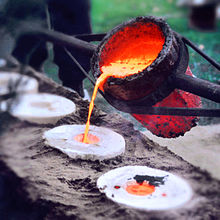
Bronze casting using the lost wax method. The molten metallic is poured into the mould.
Although the works more often than not are chosen the Benin Bronzes, they are made of different materials. Some are made of brass, which metallurgical analysis has shown to exist an alloy of copper, zinc, and lead in diverse proportions.[15] Others are non-metallic, made of forest, ceramics, ivory, leather, or material.[15]
The wooden objects are fabricated in a circuitous process. It starts with a tree trunk or branch and is carved straight. The creative person obtains the final form of the piece of work from a cake of wood. Since it was customary to utilise freshly cut forest in carvings, once the piece was finalized the surface was charred to prevent cracking during drying. This as well immune for polychromatic artworks, which were achieved using knife cuts and applications of natural pigments made with vegetable oil or palm oil. This blazon of grease, which was made virtually smoke from homes, immune the wooden sculptures to acquire a patina that resembles rusty metal.[76]
The figures depicted in the bronzes were bandage in relief with details incised in the wax model. Artists working in bronze were organized into a type of guild under royal decree and lived in a special surface area of the palace under the direct control of the Oba. The works made using lost-wax casting required swell specialization. Their quality was superior when the king was especially powerful, allowing him to apply a great number of specialists.[77]
Although the oldest examples of similar Benin metal work in bronze date from the twelfth century, according to tradition, the lost-wax casting technique was introduced to Benin past the son of the Oni, or sovereign of Ife. Their tradition holds that he taught the Benin metal workers the art of casting statuary using lost-wax techniques during the thirteenth century.[78] These great Benin artisans refined that technique until they were able to cast plaques only an 8th-of-an-inch thick, surpassing the art equally practiced by Renaissance masters in Europe.[68] [79]
Reception [edit]
One sixteenth-century bronze, depicting the Oba with Europeans, was featured in A History of the World in 100 Objects, a serial of radio programmes that started in 2010 equally a collaboration between the BBC and the British Museum; information technology was besides published as a book.[fourscore]
See also [edit]
- Looted art[81]
- Manilla (money)
- Okukor, a bronze at Jesus College, Cambridge
References [edit]
Notes [edit]
- ^ The exact number of pieces is uncertain.[i] Nigh sources speak of a 1000 pieces or several thou pieces. According to Nevadomsky, at that place were between 3,000 and 5,000 pieces in total.[2]
- ^ The British Museum notes that the term "copper alloy" is more appropriate in museology as it avoids the stardom between brass and statuary.[fourteen]
Footnotes [edit]
- ^ Dohlvik 2006, p. 7.
- ^ Nevadomsky 2005, p. 66.
- ^ British Museum, "Curator'due south comments"
- ^ Benin, The Art Institute of Chicago.
- ^ Greenfield 2007, p. 122.
- ^ "Why Jesus College shouldn't take returned its Republic of benin bronze | the Spectator".
- ^ "Benin and the Portuguese (Commodity) | Nigeria".
- ^ a b Lusher, Adam (24 June 2018). "British museums may loan Nigeria bronzes that were stolen from Nigeria by British imperialists". The Independent . Retrieved xiv December 2018.
- ^ Greenfield 2007, p. 124.
- ^ a b Benin Diplomatic Handbook, p. 23.
- ^ a b c d e f Meyerowitz, Eva Fifty. R. (1943). "Aboriginal Bronzes in the Royal Palace at Benin". The Burlington Magazine. The Burlington Magazine Publications, Ltd. 83 (487): 248–253. JSTOR 868735.
- ^ "Benin and the Portuguese". Khan Academy . Retrieved 26 November 2018.
- ^ "The kingdom of Benin".
- ^ British Museum, "Scope Note" for "copper blend". Britishmuseum.org. Retrieved 26 May 2014.
- ^ a b c Dohlvik 2006, p. 21.
- ^ Nevadomsky 2004, pp. 1, 4, 86–8, 95–6.
- ^ Willett 1985, p. 102.
- ^ a b c d Ezra, Kate (1992). Royal art of Benin: the Perls collection in the Metropolitan Museum of Art . New York: The Metropolitan Museum of Art. ISBN978-0-8109-6414-3.
- ^ Pijoan 1966, p. 12.
- ^ a b c d due east f g Plankensteiner, Barbara (22 December 2007). "Benin--Kings and Rituals: court arts from Nigeria". African Arts. University of California. 40 (4): 74–87. doi:ten.1162/afar.2007.forty.4.74. ISSN 0001-9933. S2CID 57571805. Retrieved 20 July 2010.
- ^ Gowing 1984, p. 578.
- ^ Leuzinger 1976, p. 24.
- ^ Huera 1988, p. 36.
- ^ Huera 1988, p. 37.
- ^ Willett 1985, pp. 100–1.
- ^ Obinyan, T. U. (September 1988). "The Annexation of Benin". Journal of Black Studies. Sage . 19 (1): 29–40. doi:10.1177/002193478801900103. JSTOR 2784423. S2CID 142726955.
- ^ a b c d east Benin Diplomatic Handbook, p. 21.
- ^ Dohlvik 2006, pp. 21–two.
- ^ a b Greenfield 2007, p. 123.
- ^ a b c Darshana, Soni. "The British and the Republic of benin Bronzes". ARM Information Sheet 4. Archived from the original on fifteen June 2006. Retrieved 26 July 2010.
- ^ Kiwara-Wilson, Salome. Restituting Colonial Plunder: The Instance for the Benin Bronzes and Ivories. DePaul Journal of Fine art, Engineering science & Intellectual Property Law. 2013
- ^ Huera 1988, p. 20.
- ^ Huera 1988, p. 35.
- ^ The collections listed are not exhaustive, and are intended to give the reader an thought of the dispersion of the artworks. For a more exhaustive list, consult: Dark, Philip J. C. (1973). An Introduction to Benin Art and Technology. Oxford Academy Press. pp. 78–81. ISBN978-0-xix-817191-ane.
- ^ a b McGlone, Peggy (8 March 2022). "Smithsonian to give back its collection of Benin bronzes". Washington Post . Retrieved 9 March 2022.
- ^ Robert Owen Lehman Collection, MFA Website, Accessed 7 August 2015
- ^ "(pl)Head of Queen Female parent, catalog of national museum, Szczecin". world wide web.e-zbiory.muzeum.szczecin.pl . Retrieved 31 January 2022.
- ^ "Explore the Royal Collection Online". www.rct.uk . Retrieved 1 Oct 2021.
- ^ a b Dohlvik 2006, p. eight.
- ^ Iyer, Aditya (3 Feb 2021). "'Today's fake culture war resurrects an old colonial trick'". world wide web.aljazeera.com . Retrieved 13 July 2021.
- ^ Phillips, Barnaby (17 June 2021). "The Met ought to have returned two stolen Benin Bronzes years agone". Apollo . Retrieved 13 July 2021.
- ^ Dohlvik 2006, p. 24.
- ^ a b c "Republic of benin bronzes sold to Nigeria". BBC News. 27 March 2002. Retrieved 26 July 2010.
- ^ "The art dealer, the £10m Benin Statuary and the Holocaust". BBC News. 14 March 2021. Retrieved xiii July 2021.
- ^ Phillips, Barnaby (14 March 2021). "The art dealer, the £10m Benin Bronze and the Holocaust". BBC News . Retrieved 15 March 2021.
- ^ Elwes, Christian (nine Jan 2017). "Subconscious Treasure". Entwistlegallery.com. Entwistle Gallery.
- ^ Kieron Monks (26 Nov 2018). "British Museum to return Benin bronzes to Nigeria". CNN . Retrieved 13 July 2021.
- ^ "The man who returned his grandpa'due south looted art". BBC News. 26 February 2015. Retrieved thirteen July 2021.
- ^ French republic-Presse, Agence (20 November 2018). "Easter Island governor begs British Museum to return Moai: 'You have our soul'". The Guardian . Retrieved 13 July 2021.
- ^ a b "Germany to return looted Republic of benin Bronzes to Nigeria in 2022". Deutsche Welle English language. 29 April 2021.
- ^ "Republic of benin artworks: French republic to return thrones and statues". BBC News. 23 November 2018. Retrieved xiii July 2021.
- ^ Saskya Vandoorne, Lauren Said-Moorhouse. "French republic urged to return looted fine art and amend heritage laws". CNN . Retrieved 13 July 2021.
- ^ "University of Aberdeen to repatriate 'looted' Nigerian bronze sculpture". BBC News. 25 March 2021. Retrieved 25 March 2021.
- ^ "Academy to return Benin bronze". www.abdn.air-conditioning.uk. Aberdeen Unicersity. 25 March 2021. Retrieved 25 March 2021.
- ^ Hickley, Catherine (22 March 2021). "Germany moves towards full restitution of Republic of benin bronzes". The Art Newspaper . Retrieved 23 March 2021.
- ^ van der Wolf, Marthe (vi Apr 2021). "Effort to Return Republic of benin Bronzes to Africa Remains Ongoing Challenge | Voice of America - English language". www.voanews.com . Retrieved xiii July 2021.
- ^ Dex, Robert (12 April 2021). "Church building of England to return Republic of benin Bronzes as repatriation rows rumble on". www.standard.co.uk . Retrieved 13 July 2021.
- ^ Holmes, Gareth (7 Apr 2021). "London'southward Horniman Museum—home to fifteen Benin bronzes—announces new 'transparent procedures' for looted object requests". world wide web.theartnewspaper.com . Retrieved 13 July 2021.
- ^ BENIN, NTA BROADCAST (9 August 2021). "UNVEILING OF LARGEST Bronze PLAQUE IN BENIN". Nigerian Television Authority (NTA). Archived from the original on 22 December 2021.
- ^ Omotayo, Joseph (5 August 2021). "Young Nigerian human makes largest plaque in Republic of benin kingdom, showcases it in video". Legit.ng - Nigeria news . Retrieved 5 October 2021.
- ^ Owolabi, Tife; Shirbon, Estelle (22 September 2021). "Nigerians offer artworks to British Museum in new take on looted bronzes". Reuters . Retrieved 5 Oct 2021.
- ^ "Fourth dimension Scape | Nigeria: Medical Student Turned Artist Immortalizes Great Male monarch Ewuare, Oba of Republic of benin, Unveils Largest-Ever Benin Kingdom Bronze Plaque". world wide web.timescapemag.com . Retrieved 5 October 2021.
- ^ "Nigerian Artists Offer British Museum Swap". MuseumNext. 23 September 2021. Retrieved eleven November 2021.
- ^ "Nigerian Gimmicky Art is Being Offered in Exchange for the U.K. Benin Bronzes". Observer. 22 September 2021. Retrieved five October 2021.
- ^ a b Khomami, Naomi (xv October 2021). "Cambridge college to be get-go in United kingdom to render looted Benin statuary". theguardian.com. Archived from the original on 15 October 2021. Retrieved 15 Oct 2021.
We are indeed very pleased and commend Jesus College for taking this atomic number 82 in making restitution for the plunder that occurred in Benin in 1897," said the oba of Republic of benin, Omo North'Oba N'Edo Uku Akpolokpolo, Ewuare II. "We truly hope that others will expedite the return of our artworks which in many cases are of religious importance to us. Nosotros wish to thank [Nigeria's] President Buhari and our National Commission for Museums and Monuments for their renewed efforts in securing the release of our artefacts on our behalf.
- ^ "Newcastle'southward Hancock museum to repatriate Benin Statuary stave". BBC News. 12 January 2022. Retrieved xiii January 2022.
- ^ "Colonial-era looted fine art returned to Nigeria and Benin | DW | xx.02.2022". Deutsche Welle . Retrieved 21 Feb 2022.
- ^ a b c "Sculpture: The Bronzes of Republic of benin". Time. half-dozen August 1965.
- ^ Leuzinger 1976, p. sixteen.
- ^ a b Dark, Philip (1973). An Introduction to Benin Art and Technology . Oxford: Oxford, Clarendon Press. ISBN978-0-19-817191-1.
- ^ Ben Amos, Paula (1980). The Art of Benin. London.
- ^ Fagg, William (1963). Nigerian Images. London.
- ^ Lawal, Babatunde (1977). "The Nowadays Country of Art Historical Enquiry in Nigeria: Problems and Possibilities". Journal of African History. 18 (ii): 196–216. doi:10.1017/s0021853700015498. S2CID 162396655.
- ^ Hicks. The Brutish Museums: The Benin, Colonial Violence and Cultural Restitution. Pluto Press. p. 137. JSTOR j.ctv18msmcr.16.
- ^ Hicks. The Brutish Museums: The Benin, Colonial Violence and Cultural Restitution. Pluto Printing. p. 152. JSTOR j.ctv18msmcr.17.
- ^ Beretta 1983, p. 356.
- ^ Gowing 1984, p. 569.
- ^ Huera 1988, p. 52.
- ^ "Benin Bronzes Are Scattered All Over the World. Nosotros Asked Museums That Concord Them Where They Stand up on Restitution". Artnet News. 18 May 2021. Retrieved 13 July 2021.
- ^ "Benin plaque - the Oba with Europeans". BBC. Archived from the original on 25 September 2010. Retrieved 20 Feb 2021.
- ^ Wiggins, Nick; Marc Fennell (29 November 2020). "The British stole Benin'south bronzes. Information technology'south a theft that still hurts". www.abc.net.au . Retrieved 11 July 2021.
Bibliography [edit]
- Phillips, Barnaby (2022). Boodle: Britain and the Benin Bronzes. Oneworld Publications. ISBN9780861543137.
- Beretta, Alcides; Rodenas, María Dolores (1983). Historia del Arte: La escultura del África negra (in Spanish). Vol. 2. Barcelona: Carroggio. ISBN978-84-7254-313-3.
- Docherty, Paddy (2021). Blood and Bronze: The British Empire and the Sack of Benin. London: Hurst. ISBN978-1-787-38456-nine.
- Dohlvik, Charlotta (May 2006). Museums and Their Voices: A Contemporary Study of the Benin Bronzes (PDF). International Museum Studies.
- Gowing, Lawrence, ed. (1984). Historia Universal del Arte (in Castilian). Vol. Iv. Madrid: SARPE. ISBN978-84-7291-592-3.
- Greenfield, Janette (2007). The Return of Cultural Treasures. Cambridge University Printing. ISBN978-0-521-80216-1.
- Hicks, Dan (2020). The Brutish Museums. The Republic of benin Bronzes, Colonial Violence and Cultural Restitution. Pluto Printing. ISBN9780745341767.
- Huera, Carmen (1988). Historia Universal del Arte: África, América y Asia, Arte Primitivo. Barcelona: Planeta. ISBN978-8432066900.
- Leuzinger, Elsy (1976). Arte del África negra (in Spanish). Barcelona: Ediciones Polígrafa. ISBN978-84-343-0176-iv.
- Lundén, Staffan (2016). Displaying Boodle. The Benin objects and the British Museum. Gotark Series B, Göteborgs Universitet.
- Nevadomsky, Joseph (Spring 2004). "Fine art and Science in Republic of benin Bronzes". African Arts. 37 (1): 1, 4, 86–88, 95–96. doi:x.1162/distant.2004.37.ane.1. JSTOR 3338001.
- Nevadomsky, Joseph (2005). "Casting in Contemporary Benin Art". African Arts. 38 (2): 66–96. doi:10.1162/afar.2005.38.2.66.
- Pijoan (1966). Pijoan-Historia del Arte. Vol. I. Barcelona: Salvat Editores.
- Willett, Frank (1985). African Fine art: An Introduction (Reprint. ed.). New York: Thames and Hudson. ISBN978-0-500-20103-9.
- Republic of benin Diplomatic Handbook. International Business Publications. 2005. ISBN978-0-7397-5745-1.
External links [edit]
- Benin Plaques, Museum number Af1898,0115.23, Drove Online, British Museum
Source: https://en.wikipedia.org/wiki/Benin_Bronzes
0 Response to "Portland Art Bronze Bas Relief Map of the River"
Post a Comment